




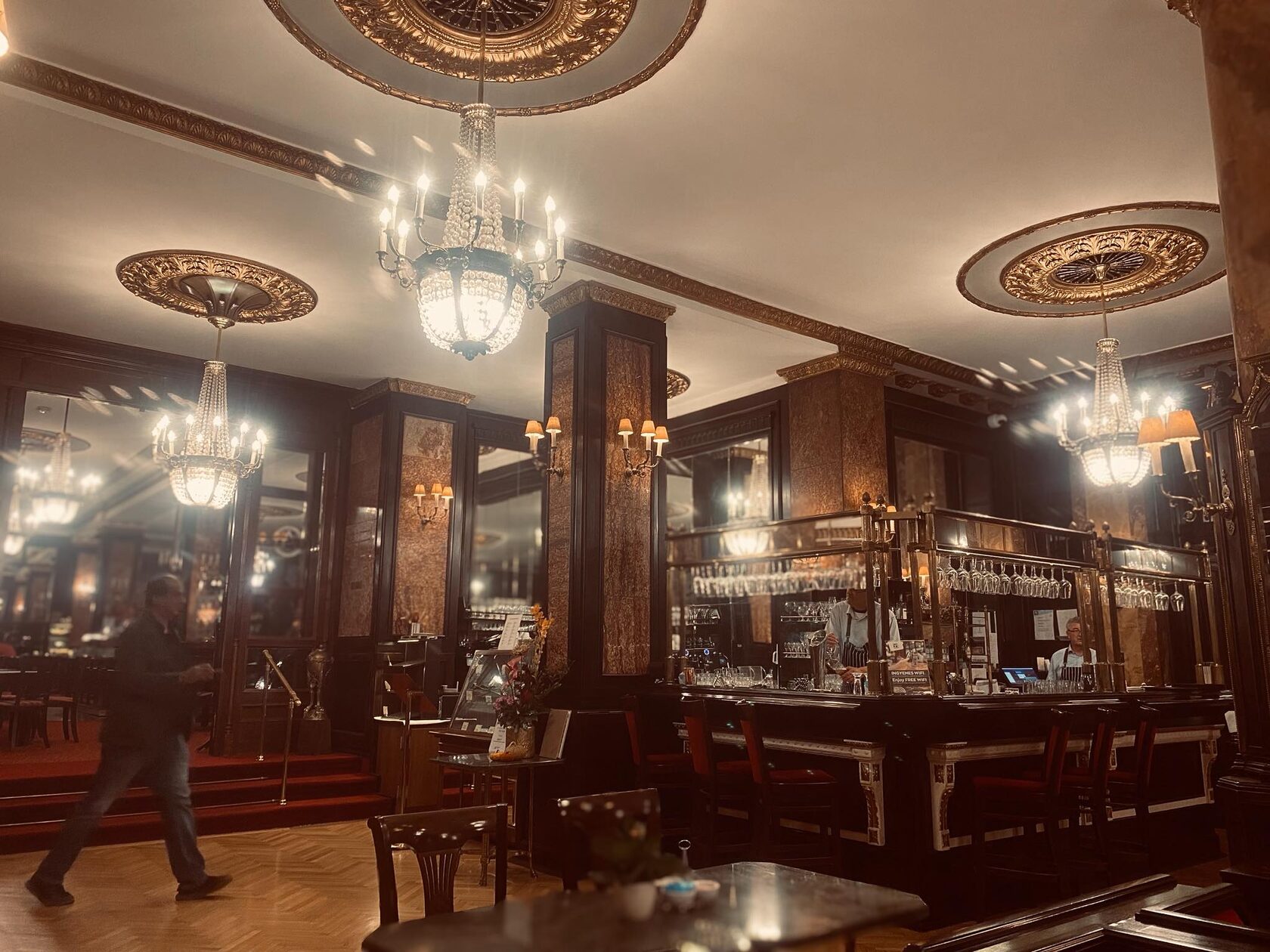
Evening after Judging at a Conductor Competition.
In the wings, the air still smelled of metal and polished wood from the stage, while behind the conductors stretched a horizon of monitors and lounge beeps. The day had been long and heavy: judging, discussions, and every step felt like a rung on a ladder between past and future. Yet now there is a pause, as quiet as before a storm, with the final tonight and two finalists tomorrow. Behind this pause lies a conversation that begins not with notes and timbres, but with people.
Ahead, by the restoration door, sits the Orator at a table surrounded by attentive listeners. His gaze is wary, his hand habitually holds a beat—echoes of the day’s judging, where one can find critique, smiles, and something else that won’t fit into any score. He begins not with praise but with what sounds like a sharp remark: the conductor led without a baton, as if the assessment were more a game of acrobats than the language of music. "There is no concertation," he says aloud, and in his words there is not anger but a longing to anchor in the collective movement of the ensemble. "The head must know everything," he adds, "but the body of the orchestra must remember it together." For a moment the backstage grows still, and one musician nods, as if hearing not accusation but guidance.
The conversation leans toward a Berlin memory, to that concert that seemed like chaos but was a complex mosaic. Boulez’s concerto at the Berlin Philharmonic, where instead of four horns there were only two, and the orchestra inspector with a superior smile counts the pipes in the hall. The soloist, young and precise, remains disciplined: he pauses, deftly retunes, taps an A on an empty score, testing reality before the final surge. "An organizational lapse," the Orator asserts, and his voice sounds not as accusation but as a reminder: music is not only beauty but precise placement on a map, where every element must be in its place so the breath of the chorus does not become contrived fuss.
From the general noise emerges a thread—Christmas Rostislavsky and his Glosses. In the mind of one of the conductors lies a rare collection of scores annotated by a master, with notes on the shelves such as "meter changes here," "trumpet reinforcement in measure 92"—fine touches that turn dull arrangements of accents into a living dialogue between conductor and orchestra. "We need to translate into English," someone says, and in that word lies not only pragmatism but a dream: that Rostislavsky’s knowledge becomes accessible to conductors around the world, so everyone can peer into this treasure and find there the language of their own solution.
Jokes circulate—an effective device to ease tension and allow the brain to repackage what it has seen. Russian jargon, the word mudak (jerk), and a tale of how a flutist at the Mariinsky is warned or punished for becoming a “jerk” at concerts. This world is saturated with living characters and informal rules: where friendship intersects with discipline, where video messages arrive at unexpected moments, where every story is a small note that could change the melody of an entire conducting life.
Then come the links and kinship threads. Renowned conductors and their children, their roles and footprints in different countries. This is not merely biography: it is a network of possibilities where every pattern could become a doorway to new collaboration. The Orator notes: "not only the score lies in our hands, but the people do too." And the people are those who can help translate Glosses into a new era, who can open access to historical examples and practices.
Beyond the conversation lie personal meetings and places. Breakfasts at the Marriott in Moscow, casual conversations among musicians after rehearsals, friendly gestures and a gentle smile after a long day. These are not distant stories—they are the everyday fabric of conductor life, where each hero and every moment leaves its mark.
Conclusions resonate as the sum of all musical diaries: organizational details—the number of staff and the distribution of instruments—are important not because someone loves numbers, but because they create the possibility for music to live on stage and beyond. Rostislavsky’s annotated scores are a valuable but under-distributed resource. Translating and publishing his book could bridge schools, eras, and continents. Personal relationships and cultural anecdotes—not merely color, but a network of possibilities through which ideas become practice. Strategic outreach to figures like Vladimir Jurowski may unlock access to more values and knowledge that once seemed out of reach.
And finally, the closing note: backstage, the fate of music is not only what sounds in the hall, but how people communicate, how they negotiate, how they learn from one another. When Judging Day ends, conductors gather not to praise their judging victories but to discuss how to make the next day more precise, more humane, and more musical.
In the wings, the air still smelled of metal and polished wood from the stage, while behind the conductors stretched a horizon of monitors and lounge beeps. The day had been long and heavy: judging, discussions, and every step felt like a rung on a ladder between past and future. Yet now there is a pause, as quiet as before a storm, with the final tonight and two finalists tomorrow. Behind this pause lies a conversation that begins not with notes and timbres, but with people.
Ahead, by the restoration door, sits the Orator at a table surrounded by attentive listeners. His gaze is wary, his hand habitually holds a beat—echoes of the day’s judging, where one can find critique, smiles, and something else that won’t fit into any score. He begins not with praise but with what sounds like a sharp remark: the conductor led without a baton, as if the assessment were more a game of acrobats than the language of music. "There is no concertation," he says aloud, and in his words there is not anger but a longing to anchor in the collective movement of the ensemble. "The head must know everything," he adds, "but the body of the orchestra must remember it together." For a moment the backstage grows still, and one musician nods, as if hearing not accusation but guidance.
The conversation leans toward a Berlin memory, to that concert that seemed like chaos but was a complex mosaic. Boulez’s concerto at the Berlin Philharmonic, where instead of four horns there were only two, and the orchestra inspector with a superior smile counts the pipes in the hall. The soloist, young and precise, remains disciplined: he pauses, deftly retunes, taps an A on an empty score, testing reality before the final surge. "An organizational lapse," the Orator asserts, and his voice sounds not as accusation but as a reminder: music is not only beauty but precise placement on a map, where every element must be in its place so the breath of the chorus does not become contrived fuss.
From the general noise emerges a thread—Christmas Rostislavsky and his Glosses. In the mind of one of the conductors lies a rare collection of scores annotated by a master, with notes on the shelves such as "meter changes here," "trumpet reinforcement in measure 92"—fine touches that turn dull arrangements of accents into a living dialogue between conductor and orchestra. "We need to translate into English," someone says, and in that word lies not only pragmatism but a dream: that Rostislavsky’s knowledge becomes accessible to conductors around the world, so everyone can peer into this treasure and find there the language of their own solution.
Jokes circulate—an effective device to ease tension and allow the brain to repackage what it has seen. Russian jargon, the word mudak (jerk), and a tale of how a flutist at the Mariinsky is warned or punished for becoming a “jerk” at concerts. This world is saturated with living characters and informal rules: where friendship intersects with discipline, where video messages arrive at unexpected moments, where every story is a small note that could change the melody of an entire conducting life.
Then come the links and kinship threads. Renowned conductors and their children, their roles and footprints in different countries. This is not merely biography: it is a network of possibilities where every pattern could become a doorway to new collaboration. The Orator notes: "not only the score lies in our hands, but the people do too." And the people are those who can help translate Glosses into a new era, who can open access to historical examples and practices.
Beyond the conversation lie personal meetings and places. Breakfasts at the Marriott in Moscow, casual conversations among musicians after rehearsals, friendly gestures and a gentle smile after a long day. These are not distant stories—they are the everyday fabric of conductor life, where each hero and every moment leaves its mark.
Conclusions resonate as the sum of all musical diaries: organizational details—the number of staff and the distribution of instruments—are important not because someone loves numbers, but because they create the possibility for music to live on stage and beyond. Rostislavsky’s annotated scores are a valuable but under-distributed resource. Translating and publishing his book could bridge schools, eras, and continents. Personal relationships and cultural anecdotes—not merely color, but a network of possibilities through which ideas become practice. Strategic outreach to figures like Vladimir Jurowski may unlock access to more values and knowledge that once seemed out of reach.
And finally, the closing note: backstage, the fate of music is not only what sounds in the hall, but how people communicate, how they negotiate, how they learn from one another. When Judging Day ends, conductors gather not to praise their judging victories but to discuss how to make the next day more precise, more humane, and more musical.