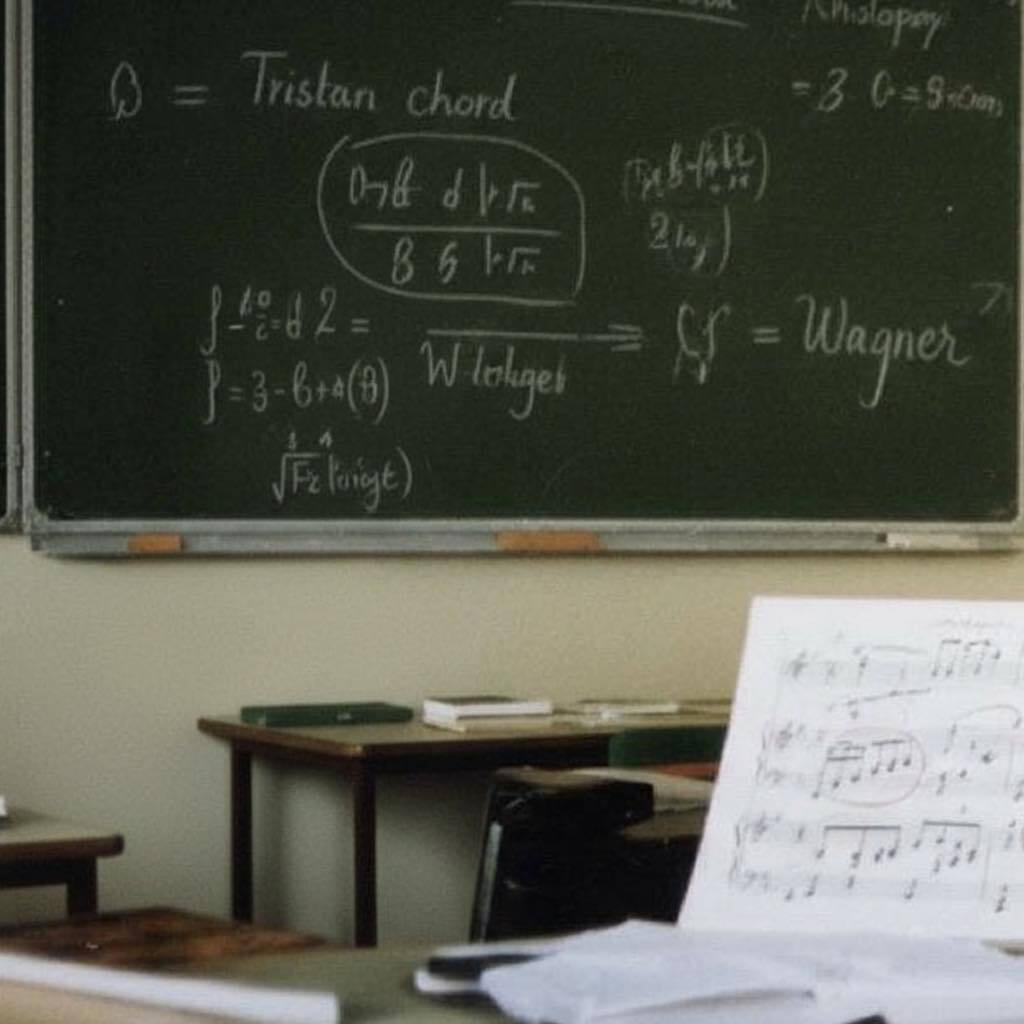
Within the walls of the Moscow Conservatory, the lectures of musicologist Yuri Kholopov were true revelations for us students. With astonishing insight, he unveiled the "secret codes" of music, and one of the most mesmerizing ciphers we encountered was the famous Tristan chord. This chord is not merely a set of notes; it is a key to understanding an entire era in music and human emotion.
Harmony on the Edge.
The Tristan chord, consisting of the notes F – B – D-sharp – G-sharp, first appears in Richard Wagner’s opera Tristan und Isolde and immediately plunges the listener into a state of ambiguity. Its unique structure challenges traditional harmony. Unlike classical chords that seek resolution into a stable key, the Tristan chord hangs in the air, self-sufficient and filled with internal tension.
As Yuri Nikolayevich Kholopov said, "The Tristan chord is the password, the cipher for all modern music, both present and future. F-B-D#-G# is a sonority that 'does not obey any single tonality' and exists on the verge of dissonance, needing no classical resolution."
In this self-sufficiency, Kholopov saw a parallel with the opera's protagonists, Tristan and Isolde, for whom only their own all-consuming love exists, outside of all social norms and rules.
As Yuri Nikolayevich Kholopov said, "The Tristan chord is the password, the cipher for all modern music, both present and future. F-B-D#-G# is a sonority that 'does not obey any single tonality' and exists on the verge of dissonance, needing no classical resolution."
In this self-sufficiency, Kholopov saw a parallel with the opera's protagonists, Tristan and Isolde, for whom only their own all-consuming love exists, outside of all social norms and rules.
A Foreboding of the Future and the Voice of Longing.
In his lectures, Yuri Kholopov pointed out that Wagner uses the Tristan chord from the very first bars of the opera, deliberately leaving it unresolved. This technique brilliantly conveys the work's main mood—an endless yearning, a sense of questioning, and an atmosphere of things left unsaid. Kholopov saw in this a premonition of 20th-century compositional techniques, noting that in the opening musical theme, the chord functions like a "series"—a central element of the serial music that would emerge decades later.
The imagery of the Tristan chord is inextricably linked to a key concept of German Romanticism — Sehnsucht. This word, which has no precise equivalent in English, signifies a deep, often painful yearning for an unattainable ideal. Wagner's chord became the sonic embodiment of this feeling, encompassing an incredibly wide spectrum of emotional shades—from existential angst to all-consuming erotic desire.
A whole philosophy is encapsulated in the sound of the Tristan chord: it is music about a desire that can never be fully quenched, about a love that finds its consummation only in death. More than a century and a half later, this "most depressing chord in music" has lost none of its power, remaining an eternal symbol of human passions and the harmonic revolution that forever changed the language of music.
The imagery of the Tristan chord is inextricably linked to a key concept of German Romanticism — Sehnsucht. This word, which has no precise equivalent in English, signifies a deep, often painful yearning for an unattainable ideal. Wagner's chord became the sonic embodiment of this feeling, encompassing an incredibly wide spectrum of emotional shades—from existential angst to all-consuming erotic desire.
A whole philosophy is encapsulated in the sound of the Tristan chord: it is music about a desire that can never be fully quenched, about a love that finds its consummation only in death. More than a century and a half later, this "most depressing chord in music" has lost none of its power, remaining an eternal symbol of human passions and the harmonic revolution that forever changed the language of music.