Conference Brochure
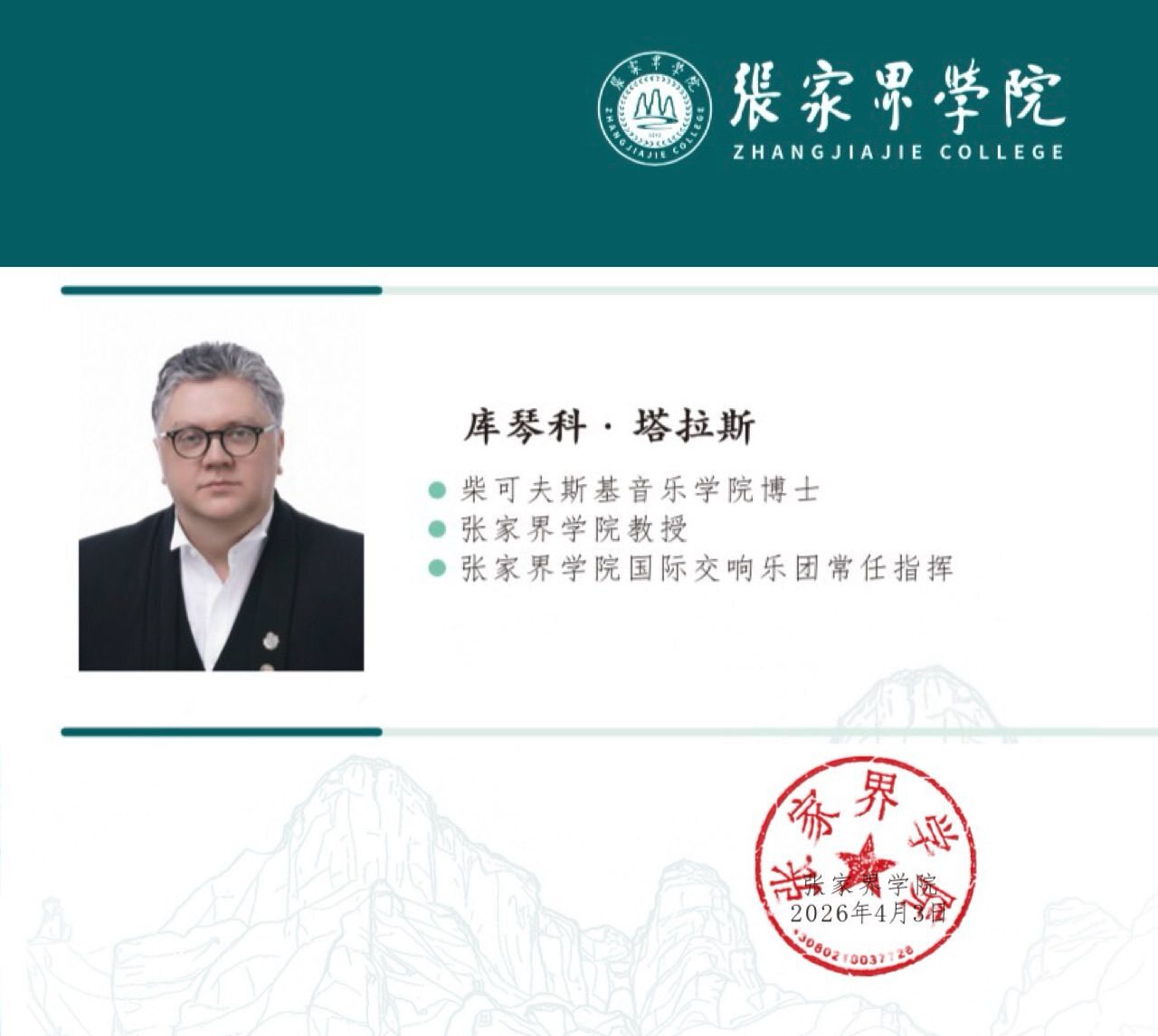
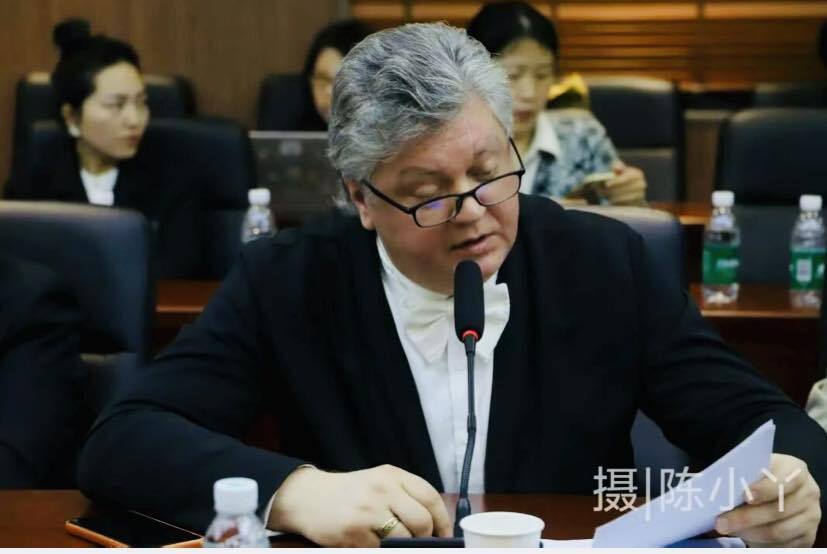
On April 11th, I had the honor of delivering a speech at a conference hosted by Zhangjiajie College.
The conference focused on how artistic creation can foster cultural exchange between China and other nations, as well as mutual learning among civilizations. It highlighted the importance of innovation and contemporary relevance in the arts, exploring art's role in building platforms for international communication and deepening cultural understanding. The profound significance of mutual learning between civilizations was also articulated from a theoretical perspective.
Title: A Score of Dual Heritage: How I, a Ukrainian Conductor, Found a Home in China.
Speaker: Professor Kuchenko Taras.
Today, what I wish to share with you is less of an academic theory and more of a living testimony—a testament to how the exchange between civilizations transformed from an abstract concept into my personal destiny. I am a conductor from Ukraine. For the past several years, the beautiful city of Zhangjiajie, China, has become my home and my artistic laboratory.
My path here was not the result of carefully calculated analysis. It was more a leap of faith, born from a deep-seated need within me—the pursuit of harmony, something I have sought my entire life as a musician. In an increasingly divided world, I was searching for a place where creation and understanding are not the exception, but the norm.
Upon my arrival in China, like many foreigners, I experienced "cultural shock." To put it in musical terms, it was a "cultural crescendo." The language barrier, different social norms, and distinct aesthetics—all of this could have been a wall. But it was here that I grasped the fundamental truth of any civilizational exchange: to understand another culture, you cannot merely observe it; you must become a part of it—to find your own voice within its orchestra.
For me, music was this universal language. When I first stepped onto the conductor's podium with the orchestra in Zhangjiajie, I was nervous. Could we understand each other? Would the Chinese musicians comprehend my European interpretation of Tchaikovsky? And could I, in turn, grasp their performance of their own native composers?
But then, a miracle happened. Music erased all boundaries and language barriers, uniting us as one. In that moment, it no longer mattered what language we spoke in our daily lives. The violins, the cellos, the flutes—they were all communicating in a universal language of emotion. I understood then that a musical score is the ideal model for mutual learning between civilizations. It has a clear structure, yet leaves room for individual interpretation; it demands discipline, but its goal is freedom of expression.
My work in China is a continuous cultural dialogue. When we perform European music, I share with the audience the deep cultural codes embedded in the works by their composers. And when we rehearse the violin concerto "The Butterfly Lovers" (梁山伯与祝英台), I become a student. I learn to understand the subtleties of the Chinese soul expressed through the pentatonic scale, to feel the breath of a melody that is woven into the cultural DNA of my Chinese colleagues.
This is not merely an exchange of performance techniques; it is an exchange of worldviews. Through my collaboration with Chinese musicians, I no longer see "harmony without uniformity" (和而不同) as a philosophical tenet, but as a daily practice. In the orchestra, each instrument is unique, with its own part to play. The violin should not sound like a trumpet, nor the oboe like a timpani. But only together, by listening to and respecting one another, can they create a unified and harmonious whole. Is this not the essence of the global vision of civilization we all aspire to?
I came to China as a Ukrainian conductor. Today, I feel I am a conductor of two cultures. I am proud to introduce European composers like Mozart, Beethoven, and Brahms to Chinese audiences and to see how enthusiastically they embrace this music. At the same time, when I visit Europe, I speak of the incredible vitality and depth of contemporary serious music in China. I am grateful to be a bridge between civilizations.
In my view, it is in this personal, human dimension that the key to successful cultural exchange lies. The key is not in formal agreements, but in shared creation; not in political declarations, but in a common endeavor—be it making music, conducting scientific research, or competing in sports.
Finding a home is about more than just finding a place to live. It is about finding your place in a community, feeling your value, and gaining a family—not of blood, but of spirit. Here in China, I have found this home. And this home is built on mutual respect and the tireless desire to learn from one another.
In closing, I want to say this: our world is in desperate need of "conductors." Not just in the musical sense. We need people who can listen to different voices, bring them together, and create harmony from what might seem like chaos. The most reliable path to this is through openness, dialogue, and a willingness not just to visit another civilization, but to find a second home within it.
The conference focused on how artistic creation can foster cultural exchange between China and other nations, as well as mutual learning among civilizations. It highlighted the importance of innovation and contemporary relevance in the arts, exploring art's role in building platforms for international communication and deepening cultural understanding. The profound significance of mutual learning between civilizations was also articulated from a theoretical perspective.
Title: A Score of Dual Heritage: How I, a Ukrainian Conductor, Found a Home in China.
Speaker: Professor Kuchenko Taras.
Today, what I wish to share with you is less of an academic theory and more of a living testimony—a testament to how the exchange between civilizations transformed from an abstract concept into my personal destiny. I am a conductor from Ukraine. For the past several years, the beautiful city of Zhangjiajie, China, has become my home and my artistic laboratory.
My path here was not the result of carefully calculated analysis. It was more a leap of faith, born from a deep-seated need within me—the pursuit of harmony, something I have sought my entire life as a musician. In an increasingly divided world, I was searching for a place where creation and understanding are not the exception, but the norm.
Upon my arrival in China, like many foreigners, I experienced "cultural shock." To put it in musical terms, it was a "cultural crescendo." The language barrier, different social norms, and distinct aesthetics—all of this could have been a wall. But it was here that I grasped the fundamental truth of any civilizational exchange: to understand another culture, you cannot merely observe it; you must become a part of it—to find your own voice within its orchestra.
For me, music was this universal language. When I first stepped onto the conductor's podium with the orchestra in Zhangjiajie, I was nervous. Could we understand each other? Would the Chinese musicians comprehend my European interpretation of Tchaikovsky? And could I, in turn, grasp their performance of their own native composers?
But then, a miracle happened. Music erased all boundaries and language barriers, uniting us as one. In that moment, it no longer mattered what language we spoke in our daily lives. The violins, the cellos, the flutes—they were all communicating in a universal language of emotion. I understood then that a musical score is the ideal model for mutual learning between civilizations. It has a clear structure, yet leaves room for individual interpretation; it demands discipline, but its goal is freedom of expression.
My work in China is a continuous cultural dialogue. When we perform European music, I share with the audience the deep cultural codes embedded in the works by their composers. And when we rehearse the violin concerto "The Butterfly Lovers" (梁山伯与祝英台), I become a student. I learn to understand the subtleties of the Chinese soul expressed through the pentatonic scale, to feel the breath of a melody that is woven into the cultural DNA of my Chinese colleagues.
This is not merely an exchange of performance techniques; it is an exchange of worldviews. Through my collaboration with Chinese musicians, I no longer see "harmony without uniformity" (和而不同) as a philosophical tenet, but as a daily practice. In the orchestra, each instrument is unique, with its own part to play. The violin should not sound like a trumpet, nor the oboe like a timpani. But only together, by listening to and respecting one another, can they create a unified and harmonious whole. Is this not the essence of the global vision of civilization we all aspire to?
I came to China as a Ukrainian conductor. Today, I feel I am a conductor of two cultures. I am proud to introduce European composers like Mozart, Beethoven, and Brahms to Chinese audiences and to see how enthusiastically they embrace this music. At the same time, when I visit Europe, I speak of the incredible vitality and depth of contemporary serious music in China. I am grateful to be a bridge between civilizations.
In my view, it is in this personal, human dimension that the key to successful cultural exchange lies. The key is not in formal agreements, but in shared creation; not in political declarations, but in a common endeavor—be it making music, conducting scientific research, or competing in sports.
Finding a home is about more than just finding a place to live. It is about finding your place in a community, feeling your value, and gaining a family—not of blood, but of spirit. Here in China, I have found this home. And this home is built on mutual respect and the tireless desire to learn from one another.
In closing, I want to say this: our world is in desperate need of "conductors." Not just in the musical sense. We need people who can listen to different voices, bring them together, and create harmony from what might seem like chaos. The most reliable path to this is through openness, dialogue, and a willingness not just to visit another civilization, but to find a second home within it.